
GPS Tracker Connectivity in Colombia: Common Failures and How to Prevent Them
Martin Pawluszek
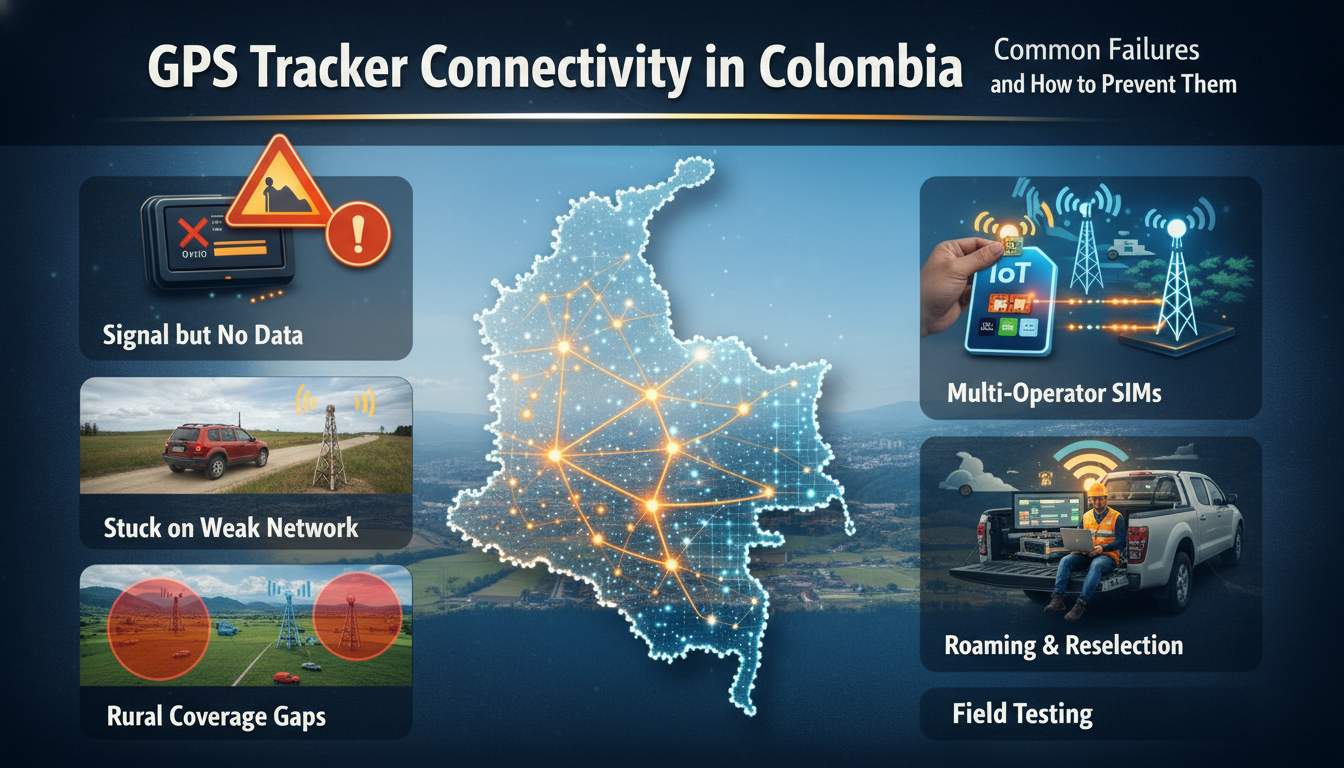
Colombia has one of the most active GPS tracking markets in Latin America. From fleet management and cargo monitoring to motorcycle recovery and logistics optimization, thousands of trackers operate daily across the country.
Yet connectivity issues remain one of the most frequent operational challenges for GPS integrators.
Understanding why trackers go offline, and how to prevent it, is critical for building reliable deployments in Colombia's unique network environment.
Why GPS Connectivity in Colombia Is Different
On paper, Colombia has strong mobile coverage. Major operators provide 4G across cities and highways, and coverage maps look reassuring.
In practice, however, GPS deployments face:
Mountainous terrain
Rural gaps outside main corridors
Network congestion in urban centers
Signal variability between operators
Cross-border fleet movement
This creates a gap between theoretical coverage and real-world performance.
For GPS integrators, that gap translates into downtime, support tickets, and field visits.
Common GPS Tracker Connectivity Failures
Talk to a connectivity expert
From multioperador global coverage to a single management platform, we keep your devices connected everywhere.
Get in touch1. The Device Shows Signal but Sends No Data
One of the most frustrating issues: the tracker appears connected, but no data reaches the platform.
Common causes include:
APN misconfiguration
Blocked data sessions
Operator-level filtering
Incorrect IP or port settings
Prevention:
Standardize APN configuration before deployment
Test data transmission, not just signal strength
Validate routing before mass installation
Signal bars alone do not guarantee working connectivity. Learn more about how APNs and IMSI work.
2. Device Gets Stuck on a Weak Network
In single-operator setups, trackers often:
Attach to the first available network
Stay connected even if signal quality drops
Fail to reattach efficiently
In Colombia's mixed terrain, this is common when vehicles move from urban to rural areas.
Prevention:
Use multi-operator roaming configurations
Ensure the device firmware supports network reselection
Test SIM behavior in motion scenarios
The ability to switch networks automatically dramatically reduces this issue.
3. Rural and Mountain Coverage Gaps
Colombia's geography creates natural signal challenges:
Andean mountain regions
Agricultural and mining areas
Secondary roads
Remote oil and energy sites
Even large operators may have uneven performance depending on the specific valley, road, or municipality.
Prevention:
Avoid dependency on a single operator footprint
Conduct real-world field testing before full rollout
Analyze connectivity logs, not just coverage maps
Multi-operator access increases the probability that at least one network has usable signal.
4. Network Congestion in Urban Areas
In cities like Bogota, Medellin, and Cali, congestion can impact data sessions during peak hours.
Symptoms include:
Delayed position updates
Packet loss
Temporary disconnections
While signal strength may remain high, data stability degrades.
Prevention:
Use connectivity solutions with optimized routing
Avoid overloaded single-network dependency
Monitor session stability, not just uptime
For high-frequency GPS reporting (every 10 to 30 seconds), network consistency matters more than raw signal strength.
5. Cross-Border Movement Interruptions
Many fleets operate between:
Colombia and Ecuador
Colombia and Panama
Colombia and Venezuela
With local SIM cards, border crossing can trigger:
Roaming restrictions
Latency spikes
Unexpected service suspension
Billing complications
Prevention:
Use roaming-first IoT SIM strategies
Ensure cross-border roaming agreements are clear
Test border scenarios before deployment
For logistics fleets, continuity across borders is often non-negotiable.
6. 2G Dependence and Legacy Devices
While Colombia still maintains 2G coverage in many regions, long-term infrastructure evolution creates risk for legacy-only devices.
Some low-cost trackers rely exclusively on 2G modules.
Prevention:
Deploy multi-band, multi-technology devices (2G + 4G LTE Cat-1 or LTE-M where available)
Plan for network sunset scenarios
Avoid hardware that locks deployments into obsolete technologies
Future-proofing reduces unexpected migration costs.
The Hidden Cost of Connectivity Failures
When a GPS tracker disconnects, the impact goes beyond missing data points.
Operational consequences include:
Customer complaints
SLA penalties
Increased support workload
Field technician dispatch
Hardware replacement assumptions (even when the issue is network-related)
In many cases, the device is not defective. The issue lies in connectivity configuration.
How to Build More Reliable GPS Deployments in Colombia
Based on field experience across LATAM markets, reliable GPS connectivity in Colombia typically requires:
Multi-operator access within the country
Proper APN and routing configuration
Devices capable of network reselection
Real-world field testing before mass deployment
Monitoring tools to detect connectivity degradation early
Coverage maps are a starting point. Network architecture determines real uptime.
Reliability Is an Architectural Decision
In Colombia's mixed urban-rural and mountainous environment, GPS tracker stability is rarely achieved by accident.
It is designed.
Choosing connectivity strategies that allow automatic operator switching, reduce single-network dependency, and adapt to cross-border movement significantly improves operational performance.
For integrators building long-term GPS fleets, connectivity should be treated as infrastructure, not just as a SIM card inserted during installation.
About Moabits
Founded in Spain in 2020, Moabits simplifies global IoT connectivity for companies that build, deploy, or resell connected solutions.
Through global SIM and eSIM coverage, smart automation, and our powerful platform Orion, we make managing connected devices seamless, so you can focus on scaling your business.
From service providers and MVNOs to OEMs and IoT solution developers, Moabits delivers the flexibility, visibility, and control needed to launch, manage, and grow smarter connectivity ecosystems worldwide.
Our Mission
Moabits empowers businesses to successfully deliver high quality connectivity services by providing a complete suite of solutions.

Our Vision
To provide technology to help connect the world, fostering global collaboration, enhancing efficiency, and improving the quality of life for all.

Let us look at your connectivity together
Whether you are scaling a fleet, deploying meters or launching a new IoT product, our team helps you choose the right coverage, plan and platform setup. Talk directly to the engineers and account managers who will run your project.
Get in touch