
From Sensor to Decision: How IoT Is Moving Beyond Telemetry Into Real Automation
Susana Oviedo
From Sensor to Decision: How IoT Is Moving Beyond Telemetry Into Real Automation
For years, when a company said it had IoT, what it really had was telemetry. Sensors that measured things. Data that arrived at a dashboard. A technician who looked at that dashboard and decided what to do.
That was a major step forward. But it was not IoT in its full version. It was IoT 1.0.
What is happening now is different. And understanding that difference matters if you already have connected devices or if you are planning to deploy them.
What telemetry is and why it is not enough
Telemetry solves a real problem: it tells you what is happening with your devices without you having to go and check them physically. A GPS fleet reporting locations. A temperature sensor sending readings every ten minutes. A consumption meter transmitting data at the end of the day.
All of that is valuable. Before it, someone had to go to the field, read the meter, write down the value, come back, and process it. Telemetry eliminated that cycle. Information arrived on its own.
But telemetry has a structural limit: it always requires someone on the other side interpreting and acting. The sensor detects that temperature rose. The technician receives the report. The technician decides if there is a problem. The technician acts. That whole cycle takes time. And time, in many operational contexts, is money or risk.
Talk to a connectivity expert
From multioperador global coverage to a single management platform, we keep your devices connected everywhere.
Get in touchThe shift: from reporting to acting
What is happening now in more mature IoT projects is that the cycle is being cut short. The sensor no longer just detects and reports. The system detects, evaluates, and acts, without waiting for a human to make the intermediate decision.
Some concrete examples of how this looks in practice:
A SIM in a vending machine detects it stopped transmitting. Instead of waiting for the operator to notice the absence of data, the system automatically restarts the connectivity module and notifies the operations team only if the restart did not solve the problem.
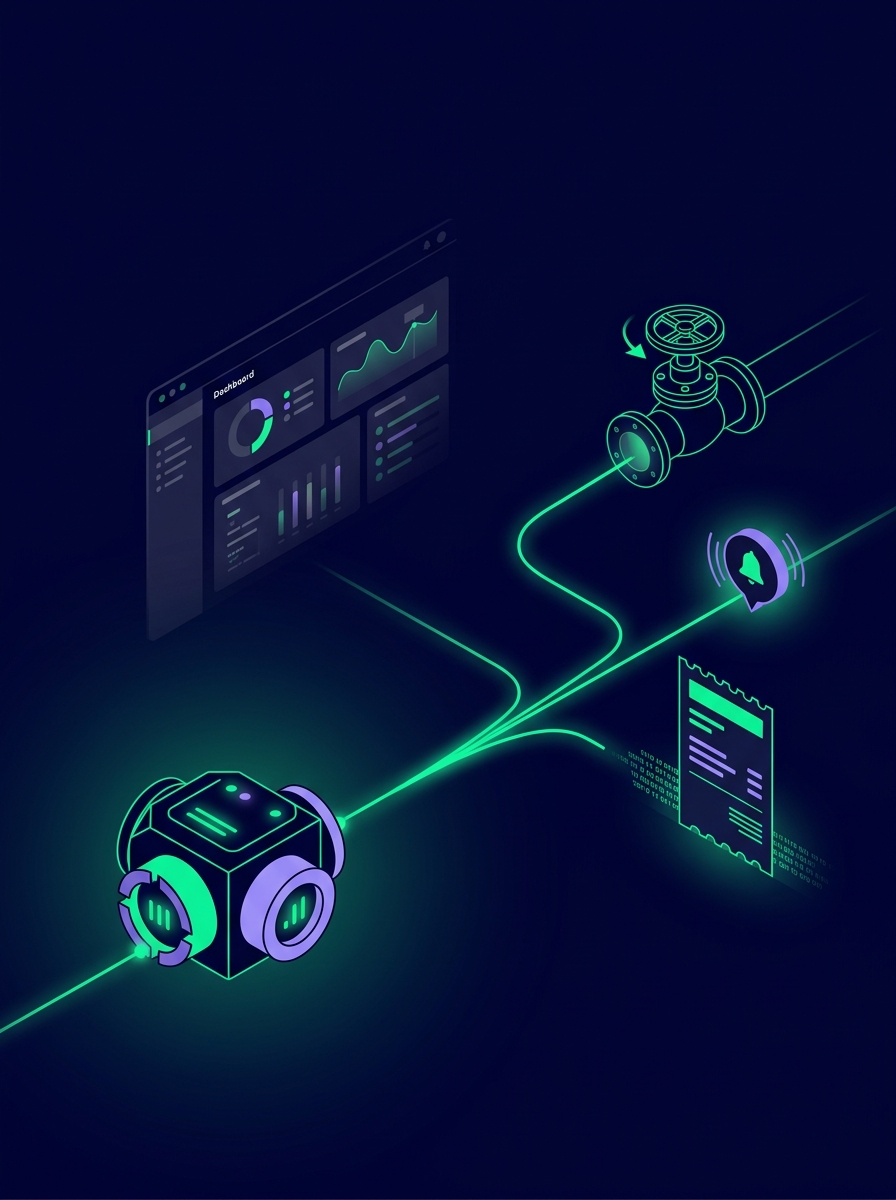
A sensor in an industrial pipeline detects that pressure dropped below a defined threshold. The system automatically closes the control valve, logs the event, and opens a maintenance ticket, all before the on-duty technician finishes reading the alert.
A fleet of GPS devices shows that several assets have been in the same location for more than twelve hours when they should be moving. The system generates an anomaly alert and automatically escalates it to the operations manager, without anyone having manually configured that rule for that specific day.
In all of these cases, the sensor is still the starting point. But the destination is no longer a dashboard waiting to be read. It is an action that has already happened.
Why this changes what is asked of connectivity
When IoT was just telemetry, a five minute delay in data transmission was acceptable. The technician looked at the dashboard, saw the day's data, and made decisions for tomorrow.
When IoT is automation, that delay changes in nature. If the system needs to detect an anomaly and act in real time, data cannot arrive with delays. If the SIM loses connectivity right when the event the system needs to detect occurs, the chain breaks. The sensor detected, but the data did not arrive, and the action was not executed.
This makes connectivity a far more critical component in IoT automation projects than in pure telemetry ones. You do not just need data to arrive. You need it to arrive at the right moment, continuously, without interruptions that break the flow of automatic decisions.
A SIM that drops for ten minutes in a telemetry system creates a gap in the report. A SIM that drops for ten minutes in an automation system can mean that a valve did not close, that an alert was not escalated, or that a machine kept running in a condition that should have stopped it.
The role of connectivity in IoT automation
For an IoT system to be able to automate decisions, it needs three connectivity guarantees that in telemetry were optional:
Continuity. Data has to flow without interruptions. Not "almost always". Always. Because automation does not have a human noticing that data stopped arriving and compensating with their judgment.
Predictable latency. A transmission that takes two seconds one moment and forty seconds the next creates inconsistencies in automation systems. Decision rules are calibrated for stable behaviors. Network variability destabilizes them.
Visibility of connectivity itself. In an automated system, knowing that a SIM lost connectivity is as important as knowing what it was measuring. If the system cannot distinguish between "no anomaly" and "no data arrived", it will operate with blind spots it cannot detect on its own.
Where LATAM is on this path
Most IoT projects in LATAM are still in the telemetry phase. That is a valid and necessary starting point. Before automating, you have to understand what data exists, how it flows, and what decisions it informs.
But companies that already have that base and are thinking about the next step are starting to ask different questions. Not "how do I see my data?" but "how do I make my data act on its own?"
And that question has a technical answer that almost always starts by reviewing whether the connectivity they have is up to what they want to build.
Because the sensor can be perfect. The automation platform can be sophisticated. But if the SIM connecting one to the other is inconsistent, the system will fail at the moment least expected.
Are you considering scaling your IoT operation from telemetry to automation? Tell us how it is designed today and we will explore together which adjustments make sense to make. You can also learn more about our IoT connectivity solutions and our Orion platform.
About Moabits
Founded in Spain in 2020, Moabits simplifies global IoT connectivity for companies that build, deploy, or resell connected solutions.
Through global SIM and eSIM coverage, smart automation, and our powerful platform Orion, we make managing connected devices seamless, so you can focus on scaling your business.
From service providers and MVNOs to OEMs and IoT solution developers, Moabits delivers the flexibility, visibility, and control needed to launch, manage, and grow smarter connectivity ecosystems worldwide.
Our Mission
Moabits empowers businesses to successfully deliver high quality connectivity services by providing a complete suite of solutions.

Our Vision
To provide technology to help connect the world, fostering global collaboration, enhancing efficiency, and improving the quality of life for all.

Let us look at your connectivity together
Whether you are scaling a fleet, deploying meters or launching a new IoT product, our team helps you choose the right coverage, plan and platform setup. Talk directly to the engineers and account managers who will run your project.
Get in touch