
How much does it really cost to operate an IoT fleet in LATAM and how to optimize the spend?
Susana Oviedo
July 7, 2026
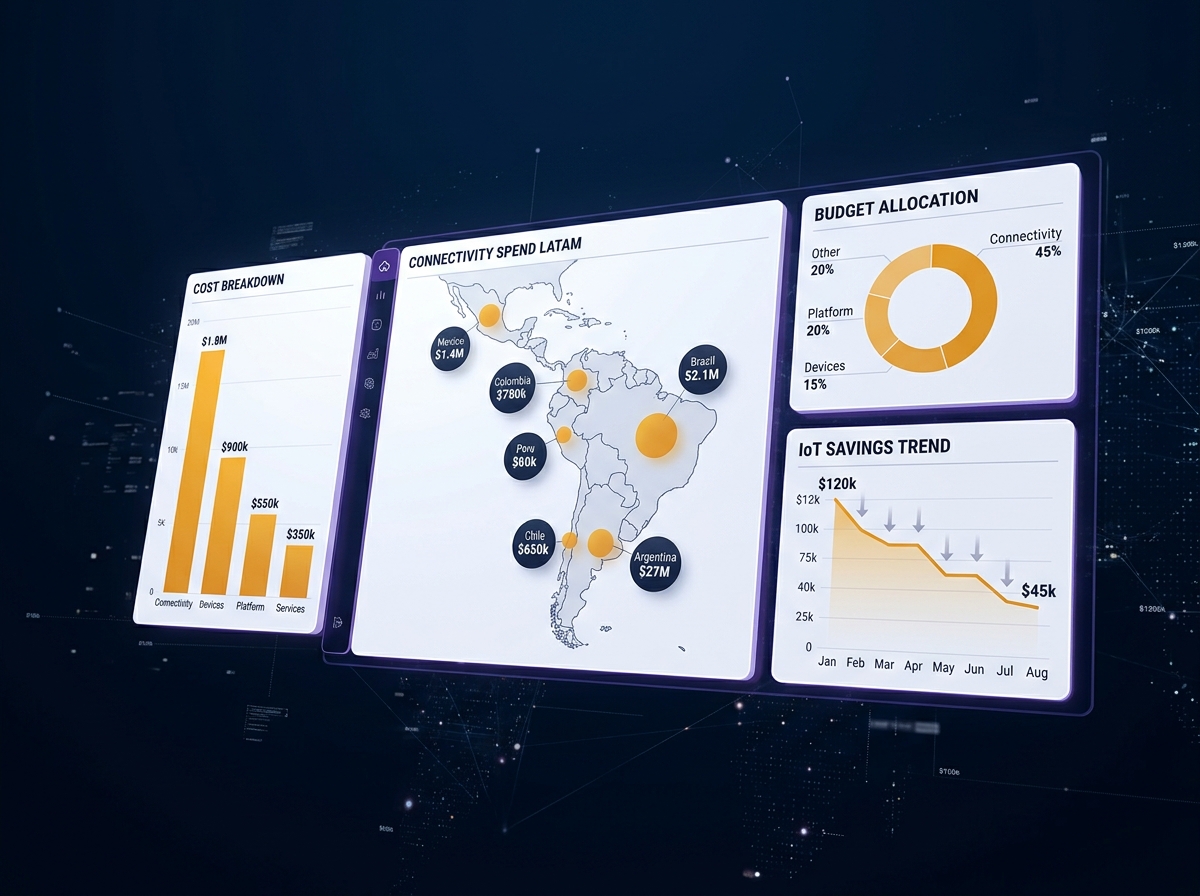
TL;DR: The real cost of operating an IoT fleet in Latin America is not the data plan price quoted by the operator, but the sum of four components: connectivity, management and platform, operational support, and hidden costs (SIMs that keep billing without transmitting, cross-border roaming, downtime). Most companies underestimate the total because they only measure the first component. Optimizing spend does not mean picking the cheapest operator: it means choosing the right pricing model per country or use case and having centralized visibility to remove spend that adds no value.
When a company budgets a new IoT fleet, it almost always starts from the per-SIM price quoted by an operator. That number is real, but it is only one piece of the total cost of ownership (TCO). The rest, management, support and hidden costs from scale and multi-country operation, usually surfaces months later, when monthly spend no longer matches the budget. Understanding that gap is the first step to optimizing real spend, not just list price.
What components make up the total cost of an IoT fleet?
Connectivity. The per-SIM data plan, which varies by operator, country and committed volume. It is the most visible component and the only one most companies compare when picking a provider. When the fleet depends on a single operator, this cost also carries the risk of coverage gaps, something multi-operator IoT connectivity mitigates by switching networks automatically.
Management and platform. The cost of monitoring, activating, decommissioning and auditing every device. Without a centralized platform like Orion, that work is done by hand with spreadsheets and multiple operator portals, turning engineering time into an indirect connectivity cost.
Operational support. Resolving connectivity incidents, negotiating with local operators and tracking per-country SLAs. In LATAM, where network quality varies between operators and regions, this cost grows with the number of countries the fleet operates in. Before scaling, it is worth validating actual coverage per country.
Hidden costs. These distort the budget the most: unexpected roaming when a device crosses borders, zombie SIMs that stay active and bill after the device stops operating, and the indirect cost of downtime, such as a sensor that goes silent and drives a wrong business decision, or a tracker that disappears from the map in transit.
Why does IoT connectivity in LATAM cost more than the data plan suggests?
In North America or Europe, an IoT fleet usually operates under a single regulatory regime with a few dominant operators. In LATAM, a mid-size fleet can span Colombia, Mexico, Chile and Peru, each with its own operators, SIM regulations and roaming agreements.
That means the per-SIM price is never a single number: it is an average that hides real variation between countries. A competitive plan in Mexico may be expensive in Peru. And when a device moves across countries without a well-negotiated roaming agreement, cost can multiply without anyone noticing until the next monthly invoice.
The complexity is not in the device: it is in the connectivity layer that connects it to each local network. For critical operations, adding a private layer with Orion Private & Dedicated Network also reduces exposure to the public internet without changing the SIM's commercial model.
Talk to a connectivity expert
From multioperador global coverage to a single management platform, we keep your devices connected everywhere.
Get in touchWhat pricing models exist and when does each one fit?
Fixed plan per device. A predictable monthly amount per SIM with a data cap. Works well for devices with stable, predictable consumption, such as smart meters or low-transmission sensors.
Shared data pool. Consumption for the whole fleet, or a group of devices, is pooled into a single data bucket. This fits when consumption varies significantly between devices (some transmit little, others a lot), because it avoids overpaying for the low-usage ones.
Pay per use. Billed strictly on consumption. Makes sense for pilot phases or small fleets where consumption is not yet predictable, but becomes more expensive than a fixed plan or a pool as the fleet scales.
There is no correct model in the abstract: it depends on the real consumption pattern, which is almost never uniform across countries or device types. The companies that best control spend combine models, fixed plan for one segment and pooled data for another, instead of forcing the whole fleet into one scheme.
How do you optimize IoT connectivity spend without sacrificing coverage?
Audit zombie SIMs. The first optimization exercise is to review how many SIMs remain active and billing without transmitting data in the last 30 or 60 days. In fleets that grew quickly without a defined decommissioning process, this is usually the most immediate source of savings.
Match the pricing model to real consumption patterns. Move from fixed plan to data pool, or the other way around, when fleet consumption changes, for example when moving from pilot to production at scale.
Consolidate multi-operator management. Negotiating and monitoring contract by contract with each operator in each country costs team time and visibility. Consolidating that management into a single orchestration layer reduces operational cost without changing operators or losing coverage.
Measure before deciding. The most common mistake is optimizing on intuition. Without centralized visibility of consumption per device, country and operator, any pricing decision is a bet. Orion integrations with internal systems make it possible to feed that data into the ERP or the company's financial dashboard.
In summary
The real cost of an IoT fleet in LATAM is made of connectivity, management, support and hidden costs, and that last group is almost always the most underestimated at budget time. Optimizing spend is not negotiating the lowest SIM price: it is picking the right pricing model for each consumption pattern and having the visibility to remove what adds no value.
Moabits combines multi-operator SIM management across 170+ countries with the Orion platform, so operations teams see the real cost of their fleet per device, per country and per operator, and can optimize spend with data instead of intuition.
Want to know how Moabits helps optimize IoT connectivity spend? Tell us how your fleet is deployed today and we'll explore together where the spend that adds no value is hiding.
About Moabits
Founded in Spain in 2020, Moabits simplifies global IoT connectivity for companies that build, deploy, or resell connected solutions.
Through global SIM and eSIM coverage, smart automation, and our powerful platform Orion, we make managing connected devices seamless, so you can focus on scaling your business.
From service providers and MVNOs to OEMs and IoT solution developers, Moabits delivers the flexibility, visibility, and control needed to launch, manage, and grow smarter connectivity ecosystems worldwide.
Our Mission
Moabits empowers businesses to successfully deliver high quality connectivity services by providing a complete suite of solutions.

Our Vision
To provide technology to help connect the world, fostering global collaboration, enhancing efficiency, and improving the quality of life for all.

Let us look at your connectivity together
Whether you are scaling a fleet, deploying meters or launching a new IoT product, our team helps you choose the right coverage, plan and platform setup. Talk directly to the engineers and account managers who will run your project.
Get in touch