
How to manage an IoT device fleet at scale without losing visibility or control?
Susana Oviedo
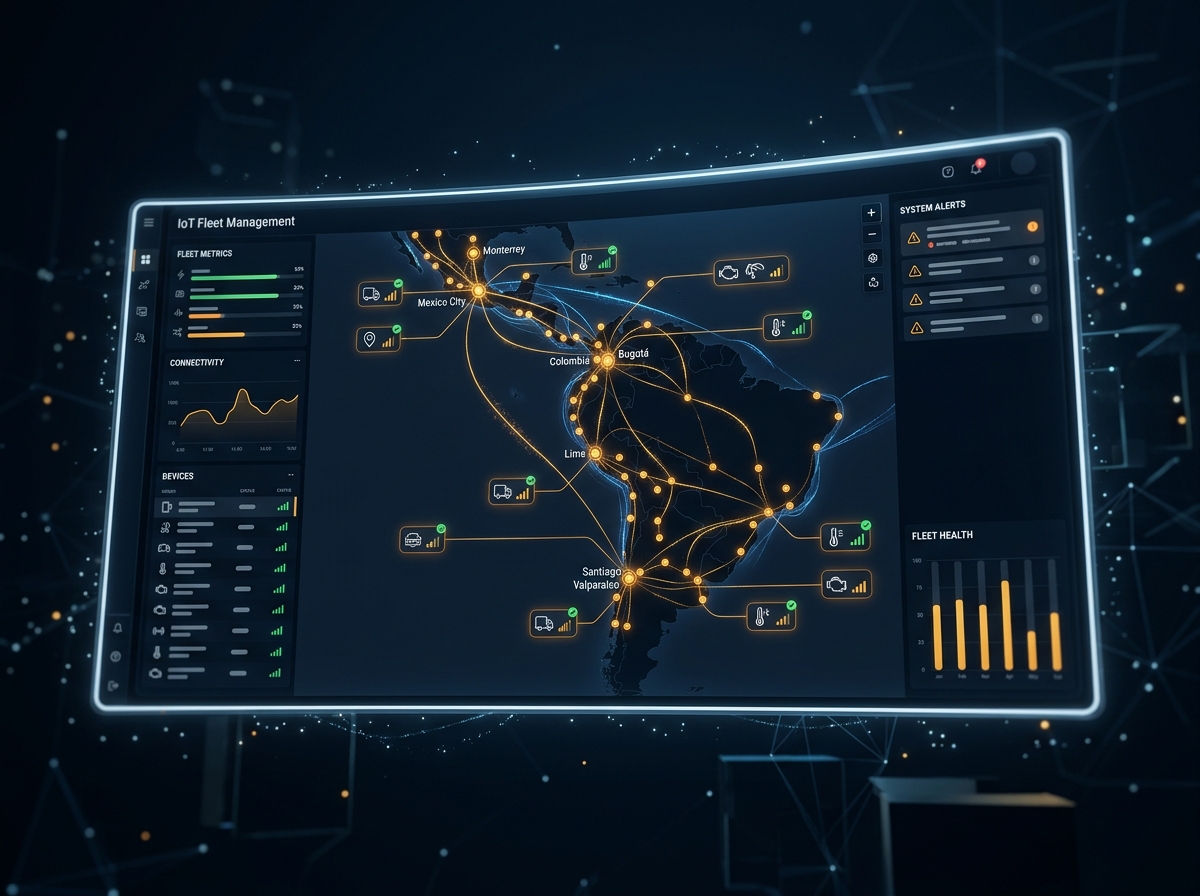
TL;DR: Managing hundreds or thousands of IoT devices distributed across LATAM requires three critical capabilities: real-time visibility into each device's state, lifecycle automation (activation, configuration, decommissioning), and intelligent alerts that distinguish real anomalies from noise. Without these centralized capabilities, operations teams lose control of the fleet as it scales, and problems with connectivity, outdated firmware, or zombie devices silently pile up until they become costly incidents.
A fleet of 50 IoT devices can be managed with a spreadsheet and some patience. A fleet of 500 starts to generate friction. A fleet of 5,000 spread across three countries, with multiple operators and several hardware models, is a serious operational problem if the right management infrastructure isn't in place.
This is the reality for most companies scaling IoT deployments in LATAM: they start with a manageable pilot and, before they know it, end up with a fleet nobody can see in a unified way.
This article explains what it takes to manage an IoT fleet at scale, which capabilities are non-negotiable, and how technical teams can avoid the most common mistakes.
Why is IoT fleet management different from traditional IT management?
In traditional IT environments (laptops, servers, smartphones) devices mostly live on the corporate network, have users who report failures, and receive automatic updates. Management is reactive, and it works because there are humans in the loop.
IoT devices have no users. A sensor on a refrigerated truck, a meter at an electrical substation, or a tracker on a port container operates in silence. If it stops transmitting data, nobody notices until there is an operational problem: the truck arrived at its destination without a temperature record, the meter has gone three days without reporting consumption, the container fell off tracking.
On top of that, scale and geographic distribution complicate everything. In LATAM, a mid-size fleet can span Colombia, Mexico, Chile, and Peru simultaneously, with devices operating across networks from different operators, with varying latencies, local outages, and SIM regulations that change from country to country.
Which capabilities are non-negotiable to manage an IoT fleet at scale?
Unified real-time visibility. The first requirement is being able to see every device on a single dashboard: connectivity status, data consumption, last transmission, active alerts. Without centralized visibility, the operations team works blind, or worse, with multiple dashboards from different providers that never show the same number.
Lifecycle management. IoT devices have well-defined stages: initial provisioning, activation, operation, maintenance, decommissioning. Managing those stages manually at scale is unfeasible. Modern management platforms automate SIM activation when the device powers on, apply network policies per device profile, and allow bulk decommissioning or SIM rotation without manual intervention.
Intelligent alerts, not mass alerts. A fleet of 1,000 devices can generate dozens of alerts per hour: reconnections, latency spikes, micro-outages. The problem is not lack of data: it's the inability to tell which alerts require immediate action. Mature management systems group events by pattern, correlate anomalies with operator network events, and prioritize by operational impact.
Remote firmware updates (OTA). A device with outdated firmware is an operational and security risk. The ability to roll out over-the-air updates in segments (a pilot group first, then a mass rollout) is critical for fleets that cannot be accessed physically.
Reporting and traceability. Operations teams need to be able to audit what happened with each device: when it connected, how much it consumed, what alerts it generated, what configuration changes it received. This isn't just for troubleshooting. In regulated industries like healthcare, energy, or cold-chain logistics, it's a compliance requirement.
Talk to a connectivity expert
From multioperador global coverage to a single management platform, we keep your devices connected everywhere.
Get in touchWhat are the most common mistakes when scaling an IoT fleet?
Fragmenting management per provider. When a company works with three different telecom operators in LATAM, it ends up using three different management portals. Visibility breaks. The solution is a centralized orchestration layer that abstracts the underlying operators.
Failing to plan the lifecycle from day one. Many companies provision devices without defining how they will be decommissioned. The result is active SIMs that no longer transmit data but keep generating cost: so-called "zombie devices". In large fleets, this can represent between 5% and 15% of connectivity spend.
Confusing monitoring with management. Seeing that a device is disconnected is monitoring. Being able to act on that device (restart the session, change the network profile, send a remote command) is management. Platforms that only monitor leave the operations team with visibility but no response capability.
How does multi-country connectivity affect fleet management?
In LATAM, fleet management and connectivity management are inseparable. A device that crosses the border between Colombia and Venezuela doesn't just face a network change. It faces different roaming agreements, different latencies, possible APN blocks, and signal quality variations that directly affect application behavior.
A fleet management platform that doesn't understand the connectivity layer can't solve these problems. The technical team ends up debugging blind: is it a device issue, a firmware issue, a local network issue, or a home operator issue?
The answer to this problem is the integration between device management and SIM management: having on the same dashboard the device status, the SIM status, the active operator, and per-session data consumption.
In summary
Managing an IoT fleet at scale in LATAM is not a hardware or application software problem: it's an operations infrastructure problem. Companies that solve it well combine centralized visibility, lifecycle automation, and a connectivity layer that abstracts multi-country complexity.
Moabits integrates multi-operator SIM management with the Orion platform so technical teams have visibility and control over the entire fleet from a single place, regardless of which country devices operate in or which operator they use at any given moment.
Want to know how Moabits manages IoT fleets across multiple countries? Tell us how your fleet is deployed today and we'll explore together how to bring it under visibility and control from Orion.
About Moabits
Founded in Spain in 2020, Moabits simplifies global IoT connectivity for companies that build, deploy, or resell connected solutions.
Through global SIM and eSIM coverage, smart automation, and our powerful platform Orion, we make managing connected devices seamless, so you can focus on scaling your business.
From service providers and MVNOs to OEMs and IoT solution developers, Moabits delivers the flexibility, visibility, and control needed to launch, manage, and grow smarter connectivity ecosystems worldwide.
Our Mission
Moabits empowers businesses to successfully deliver high quality connectivity services by providing a complete suite of solutions.

Our Vision
To provide technology to help connect the world, fostering global collaboration, enhancing efficiency, and improving the quality of life for all.

Let us look at your connectivity together
Whether you are scaling a fleet, deploying meters or launching a new IoT product, our team helps you choose the right coverage, plan and platform setup. Talk directly to the engineers and account managers who will run your project.
Get in touch