
What Makes an IoT SIM Different from a Regular SIM Card?
Martin Pawluszek
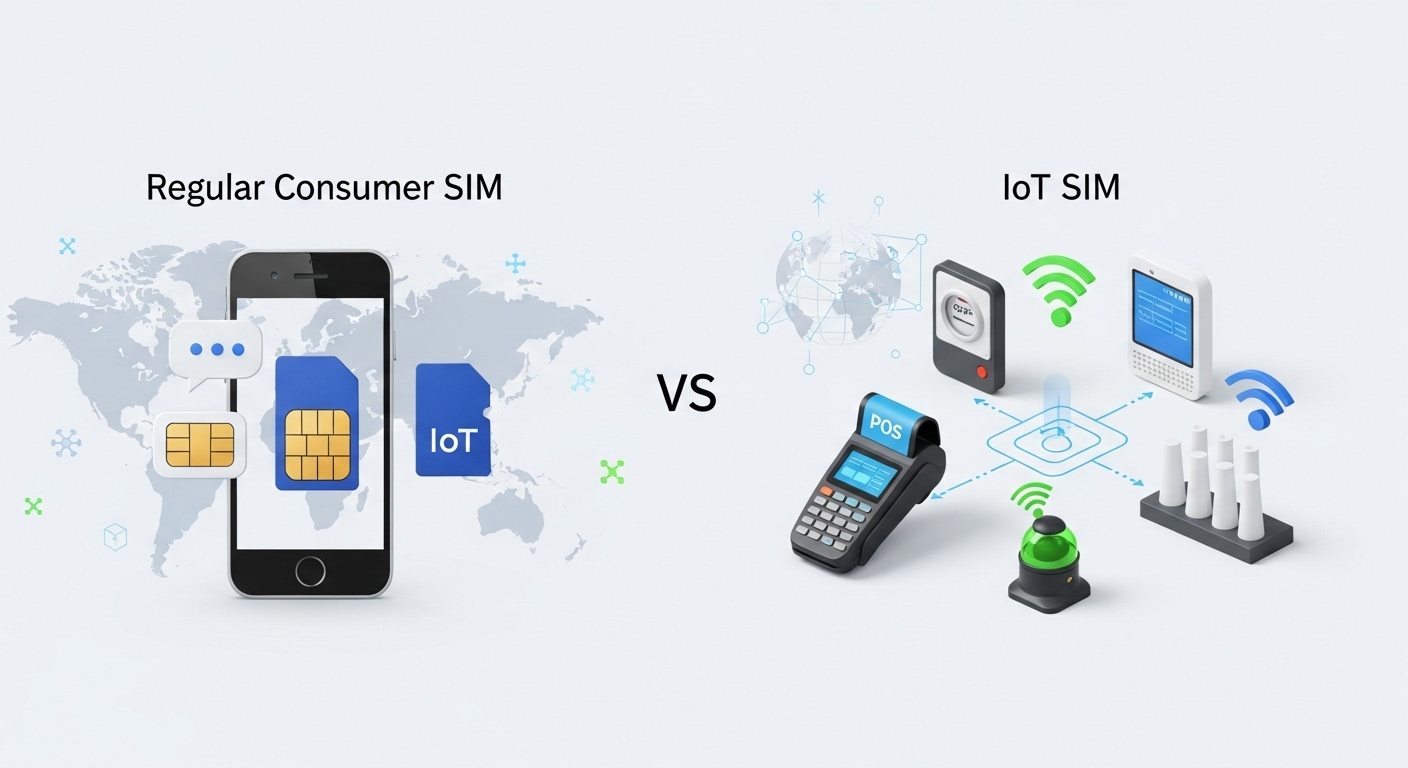
When people think about IoT devices (GPS trackers, POS terminals, smart meters) they often focus on hardware or software.
But behind every connected device, there's something smaller and just as essential: the SIM card.
In IoT, not all SIMs are created equal. While a regular SIM keeps your phone connected, an IoT SIM is built for machines, designed for constant, secure, and automated communication between devices.
Why the SIM Card Matters in IoT
The SIM card is the gateway to cellular networks. For IoT deployments, choosing the right type of SIM determines whether your devices stay connected, secure, and cost-effective over time.
Many companies underestimate this decision, only to face disconnections, unexpected costs, or operational headaches later.
The Basic Difference: People vs. Machines
Regular SIMs are designed for human users, with high and irregular data use, short sessions, fixed to one operator, and connected over public internet.
IoT SIMs are designed for machines, with low and consistent data use, always-on long sessions, multi-network connectivity, centralized remote management, and private or encrypted APNs.
In short: a regular SIM connects people, an IoT SIM connects systems.
Talk to a connectivity expert
From multioperador global coverage to a single management platform, we keep your devices connected everywhere.
Get in touchWhy Regular SIMs Fail in IoT Devices
Regular SIM cards are made for smartphones, where users move between apps, browse the web, or make calls. They rely on interactive, short sessions and human-driven activity.
IoT devices, on the other hand, transmit small data packets continuously, often from remote locations with no user interaction.
When companies use consumer SIMs in IoT devices, they often face:
Unexpected disconnections or timeouts.
SIMs deactivated due to inactivity.
Lack of visibility over device performance.
Coverage gaps in areas with weak signal.
Unexpected roaming costs.
What Makes an IoT SIM Different
Multi-Network Connectivity
IoT SIMs can automatically switch between mobile operators, always connecting to the strongest signal available. That's critical in Latin America, where network quality varies by region and operator.
Check our coverage map to see all supported countries and networks.
Long-Term Reliability
IoT SIMs are designed for constant uptime, handling millions of small data transmissions without interruption, ideal for GPS tracking, telemetry, and smart metering.
Remote Management
Through an IoT platform, companies can monitor, activate, or suspend SIMs remotely, no need to handle each device physically.
Enhanced Security
IoT SIMs support private APNs, VPNs, and encrypted communication, keeping device data safe from public internet exposure.
Learn more about our secure connectivity solutions.
Optimized Data Plans
Instead of gigabytes per month, IoT data plans are measured in megabytes, more affordable and aligned with real device usage.
Why This Matters for IoT Deployments
For a GPS provider, a smart metering company, or a security system integrator, connectivity is the invisible foundation of their service.
An IoT SIM ensures that devices:
Stay connected 24/7.
Communicate securely.
Work seamlessly across countries and operators.
Scale easily with centralized control.
Regular SIMs simply can't offer that level of reliability, security, or flexibility.
Moabits' Perspective: Building Connectivity That Lasts
At Moabits, we see every day how switching from regular SIMs to multi-operator IoT SIMs transforms device performance.
From fewer disconnections to better cost efficiency, the difference is not just technical, it's operational.
IoT SIMs aren't just "better chips", they're the backbone of reliable, scalable connectivity across Latin America and beyond.
Want to understand how IoT SIMs can make your devices more reliable? Follow our weekly insights on IoT connectivity, innovation, and scalability in Latin America.
About Moabits
Founded in Spain in 2020, Moabits simplifies global IoT connectivity for companies that build, deploy, or resell connected solutions.
Through global SIM and eSIM coverage, smart automation, and our powerful platform Orion, we make managing connected devices seamless, so you can focus on scaling your business.
From service providers and MVNOs to OEMs and IoT solution developers, Moabits delivers the flexibility, visibility, and control needed to launch, manage, and grow smarter connectivity ecosystems worldwide.
Our Mission
Moabits empowers businesses to successfully deliver high quality connectivity services by providing a complete suite of solutions.

Our Vision
To provide technology to help connect the world, fostering global collaboration, enhancing efficiency, and improving the quality of life for all.

Let us look at your connectivity together
Whether you are scaling a fleet, deploying meters or launching a new IoT product, our team helps you choose the right coverage, plan and platform setup. Talk directly to the engineers and account managers who will run your project.
Get in touch